Affiliate Disclosure: This page may contain affiliate links. If you buy through these links, PrintPilotLab may earn a small commission at no extra cost to you.
Material Guide
Best Resin Types for 3D Printing
What to use for miniatures, prototypes, flexible parts, casting, clear prints, high-temperature parts, and beginner resin workflows.
Quick Answer
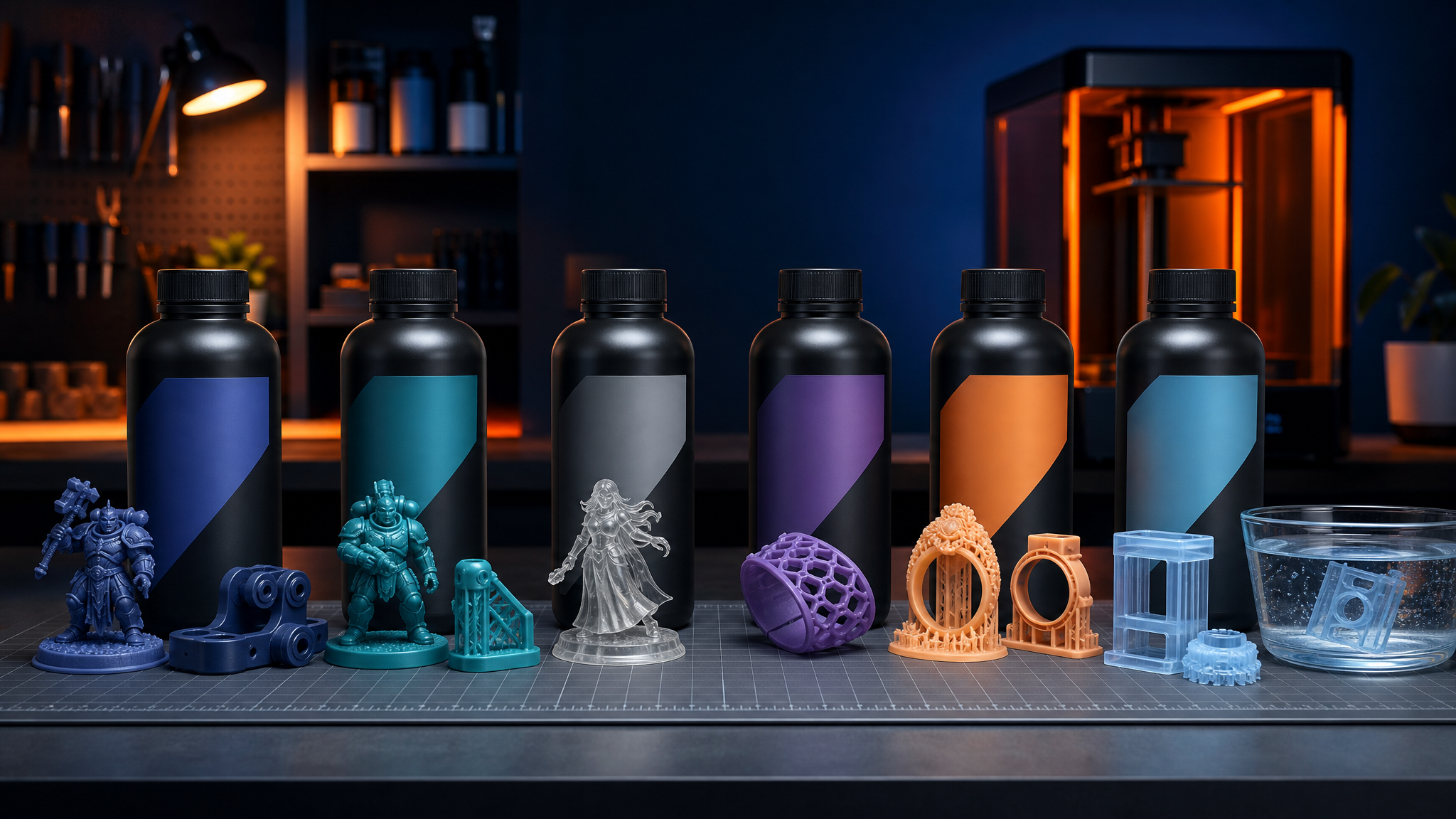
For most home resin printers, start with a gray ABS-like resin. It is easier to inspect than black or clear resin, less brittle than basic standard resin, and useful for miniatures, display parts, and general prototypes. Use standard resin for cheap detail tests, tough resin for stronger parts, flexible resin for rubber-like details or blending, castable resin for jewelry workflows, and clear or high-temp resin only when the project specifically needs those properties.
Resin choice changes how a print behaves more than many beginners expect. Two bottles can both say “405nm resin,” but one may produce crisp-but-brittle display parts while another survives small drops, bends slightly before snapping, or burns out cleanly for jewelry casting.
The right question is not “what is the strongest resin?” It is “what does this print need to survive?” A miniature, a phone-button prototype, a flexible tire, and a clear display part all want different materials.
Safety First
All uncured UV resin should be treated as a skin and eye irritant. Wear nitrile gloves and eye protection, ventilate the workspace, cure contaminated paper towels/supports before disposal when appropriate, and never pour uncured resin or resin-contaminated wash water down the drain.
| Resin Type | Best For | Strengths | Weaknesses |
|---|---|---|---|
| Standard resin | Lowest-cost detail prints, display models, test exposure settings | Sharp detail, cheap, widely available | Brittle; not ideal for clips, thin weapons, or parts that may be dropped |
| ABS-like resin | Miniatures, hobby parts, general-purpose prototypes | Less brittle than standard; good first “daily driver” resin | Still not true ABS; properties vary a lot by brand |
| Tough / engineering resin | Functional prototypes, snap-fit tests, brackets, higher-impact parts | Better impact and flex resistance | More expensive; may need more careful exposure and supports |
| Water-washable resin | Users who want simpler cleanup without IPA baths | Convenient cleanup workflow | Rinse water is toxic resin waste; often more brittle than ABS-like options |
| Flexible / elastic resin | Tires, gaskets, grips, soft details, resin blends | Rubbery parts and impact-modifying blends | Can be slow, sticky, and difficult to support cleanly |
| Castable resin | Jewelry masters and investment casting | Designed to burn out cleaner than standard resin | Specialized; requires casting knowledge and burnout schedule |
| Clear resin | Light pipes, transparent props, lenses-ish display parts | Can polish or clear-coat to look glassy | Yellows/clouds easily; every layer/support mark shows |
| High-temp resin | Molds, fixtures, heat-exposed prototypes | Better heat resistance than hobby resin | Expensive and more brittle/specialized |
| Plant-based / low-odor resin | Users prioritizing lower odor and easier home workflow | Often smells less harsh; beginner friendly | Still requires PPE, ventilation, curing, and proper disposal |
01
Standard Resin
Best for: cheap detail tests, display models, exposure calibration, tabletop terrain, and prints that will sit on a shelf.
Strengths: Standard resin is usually the cheapest resin per bottle, easy to find, and capable of very crisp detail. It is a good way to learn supports, exposure, washing, curing, and failure diagnosis without burning through expensive specialty material.
Weaknesses: It is commonly brittle. Thin swords, miniatures with delicate limbs, clips, pegs, and parts that get dropped can snap more easily than prints made with ABS-like or tough resin.
PrintPilotLab take: Use standard resin when cost matters more than durability. For a first resin bottle, we still prefer gray over black, white, or clear because details and support marks are easier to inspect.
Elegoo Standard Photopolymer Resin
Good low-cost baseline resin for learning exposure and support cleanup.
Anycubic Standard Resin
Widely available budget option for display prints and calibration work.
02
ABS-Like Resin
Best for: miniatures, gaming pieces, props, prototypes, model parts, and general-purpose resin printing.
Strengths: ABS-like resin is usually less brittle than standard resin while still preserving good detail. It is the easiest everyday recommendation for most hobby users because it balances detail, price, and survivability.
Weaknesses: “ABS-like” is a marketing category, not a guarantee that the part behaves like injection-molded ABS. Some formulas are only slightly tougher than standard resin, while others are noticeably more impact resistant.
PrintPilotLab take: If you only buy one resin type, make it a gray ABS-like resin from a brand with lots of community settings.
Siraya Tech Fast ABS-Like Resin
A popular hobby choice for detailed miniatures and general resin parts.
Anycubic ABS-Like Resin Pro 2
Good mainstream ABS-like option for stronger everyday resin prints.
Elegoo ABS-Like Resin 3.0
Easy-to-find ABS-like option for minis and hobby prototypes.
03
Tough / Engineering Resin
Best for: stronger prototypes, brackets, jigs, clips, snap-fit tests, RC parts, and parts that may see light handling or impact.
Strengths: Tough resins are designed to absorb more stress before cracking. They can be a better fit when a print needs to be handled, assembled, or tested instead of only displayed.
Weaknesses: They cost more, may print slower, and may need more tuning. Tough does not mean indestructible, and resin parts are still usually not the right choice for high-load mechanical parts unless you understand the material limits.
PrintPilotLab take: Use tough resin when a normal miniature resin keeps snapping. For many users, blending a small amount of flexible/tough resin into ABS-like resin is also a useful path, but test blends carefully.
Siraya Tech Blu Tough Resin
Popular stronger resin for functional prototypes and tougher hobby parts.
Anycubic Tough Resin
Mainstream tough resin option for more durable resin prints.
Phrozen TR250LV High Impact Resin
Tougher specialty resin for users who want more impact resistance.
04
Water-Washable Resin
Best for: users who want to reduce IPA handling and simplify cleanup logistics.
Strengths: Water-washable resin can make the cleanup workflow feel less intimidating because you can wash uncured resin from prints with water instead of an IPA bath.
Weaknesses: The water becomes contaminated resin waste. It should not go down the sink. Water-washable resins can also be more brittle than ABS-like resins, and over-soaking parts can cause issues.
PrintPilotLab take: Buy it for convenience, not because it is “safer.” You still need gloves, ventilation, curing, and a responsible waste plan.
Elegoo Water Washable Resin
Common water-washable option for beginners who want simpler cleanup.
Anycubic Water-Wash Resin+
Mainstream water-washable resin with broad printer compatibility.
05
Flexible / Elastic Resin
Best for: tires, gaskets, buttons, grips, protective corners, soft details, and blending with brittle resin.
Strengths: Flexible resin can bend, compress, or rebound in ways standard resin cannot. It is also useful as a modifier: some makers blend a small percentage into standard or ABS-like resin to reduce brittleness.
Weaknesses: Flexible resin is usually messier, slower, and harder to support. Very soft prints can peel from supports, deform during washing, or require longer cure experiments.
PrintPilotLab take: Do not make this your first bottle. Learn standard/ABS-like resin first, then add flexible resin when you have a project that actually needs rubber-like behavior.
Siraya Tech Tenacious Flexible Resin
Popular flexible additive/resin for improving impact resistance or printing bendable parts.
Resione F69 Flexible Resin
Flexible specialty resin for soft parts and rubber-like prototypes.
06
Castable Resin
Best for: jewelry masters, rings, small metal parts, and investment casting workflows.
Strengths: Castable resin is designed to burn out more cleanly than normal resin, reducing ash and defects during casting when used with the right process.
Weaknesses: It is not a general-purpose resin. It is expensive, may be brittle, and depends heavily on correct slicing, curing, investment, and burnout schedules.
PrintPilotLab take: Only buy castable resin if you are actually casting. For display jewelry mockups, standard or ABS-like resin is cheaper.
Siraya Tech Cast Castable Resin
Popular castable resin for jewelry and burnout workflows.
Anycubic Castable Resin
Accessible castable option for jewelry-style workflows.
07
Clear Resin
Best for: translucent props, clear cases, light pipes, visual prototypes, water effects, and parts where seeing through the print matters.
Strengths: Clear resin can create effects that opaque resin cannot. With sanding, polishing, and clear coat, it can look impressively glassy for display pieces.
Weaknesses: It shows every support mark, scratch, layer artifact, and trapped bubble. Clear resin can also yellow with over-curing or UV exposure, and it usually takes more finishing work than beginners expect.
PrintPilotLab take: Clear resin is a finishing project, not just a print setting. Budget time for sanding and clear coating if appearance matters.
Anycubic High Clear Resin
Good option for transparent display parts and visual prototypes.
Elegoo Clear Blue / Translucent Resin
Affordable clear/translucent resin for decorative prints and effects.
08
High-Temperature Resin
Best for: heat-exposed prototypes, mold masters, tooling aids, fixtures, and parts that need better heat resistance than normal hobby resin.
Strengths: High-temp resin can resist deformation at higher temperatures, which makes it useful for specialized workshop and engineering applications.
Weaknesses: It is usually more expensive, more brittle, and less forgiving than everyday resin. Some formulas need careful post-curing to reach their advertised properties.
PrintPilotLab take: Do not buy high-temp resin for normal minis. Buy it when heat resistance is the specific problem you are solving.
Siraya Tech Sculpt High Temp Resin
Specialty resin for heat-resistant models, molds, and prototypes.
Phrozen TR300 Ultra-High Temp Resin
High-temperature specialty resin for advanced resin users.
09
Plant-Based / Low-Odor Resin
Best for: users who want a less harsh-smelling beginner resin and a more pleasant home workflow.
Strengths: Many plant-based or low-odor resins smell less aggressive than older standard resins and are easy to find from major brands.
Weaknesses: Lower odor does not mean safe to touch or safe to breathe without ventilation. It still needs gloves, eye protection, curing, and proper waste handling.
PrintPilotLab take: This can be a nice quality-of-life choice, but do not let the label make you careless.
Anycubic Plant-Based Resin
Common low-odor option for beginner resin printing workflows.
Elegoo Plant-Based Resin
Accessible plant-based resin option for general hobby prints.
10
Best Resin by Use Case
- First resin bottle: gray ABS-like resin
- Cheapest detail tests: standard gray resin
- Miniatures that get handled: ABS-like or ABS-like plus a flexible/tough blend
- Functional prototypes: tough/engineering resin
- Jewelry casting: castable resin
- Translucent effects: clear resin with post-processing
- Heat-exposed parts: high-temp resin
- Simpler washing: water-washable resin, with proper wastewater handling
11
How to Test a New Resin
When you switch resin types, do not immediately print a full plate of models. Run a small exposure test, then print one known model with familiar supports. Record resin brand, color, temperature, layer height, exposure, lift speed, and cure time. Resin settings are sensitive to color, room temperature, printer screen output, and part geometry.
PrintPilotLab Bottom Line
If you are new to resin printing, buy a gray ABS-like resin first. It gives beginners the best mix of detail, durability, price, and troubleshooting visibility. Add specialty resin only when a project demands it — flexible for bend, castable for burnout, clear for transparency, tough for impact, and high-temp for heat.